
CRM & Sales
Why 2026 Is the Perfect Time to Set Up Your Small Business CRM (And What Happens If You Don't)
December 3, 2025

TL;DR
Setting up a small business CRM in early 2026 gives you a competitive advantage most businesses won’t take. Q1 timing means you have breathing room to implement systems before your busy season, fresh 2025 data to guide your setup, and an entire year to compound results. Businesses using CRM see an average ROI of $8.71 for every dollar spent, with revenue increases up to 245%. The alternative? Another year of lost leads, missed follow-ups, and the same manual grind that burned you out in 2025.
Most businesses started 2025 the same way they started 2024: with good intentions, a mental list of things to fix, and a vague plan to “get more organized this year.”
By February, those resolutions had faded. By March, they were buried under the usual chaos. By December, they were making the same promises for 2026.
Sound familiar?
Here’s the reality: 2026 doesn’t have to be a repeat of 2025. But only if you do something different.
The single most impactful change you can make? Set up a small business CRM in the first quarter of 2026. Not “eventually.” Not “when things slow down.” Now. January. February at the latest.
Businesses that start 2026 with systems in place don’t just have a better year—they build a fundamentally different business by December. And businesses that wait? They face another year of the same struggles, the same lost leads, the same feeling of being one step behind.
Let’s talk about why 2026 is different, why now is the moment, and what your business will look like twelve months from now depending on what you do in the next few weeks.
How Most Businesses Started 2025 (And Why It Didn’t Work)
Let’s rewind to January 2025. Maybe this was you.
January Resolutions That Faded by February
You started the year with energy. This was going to be the year you finally got organized. You were going to follow up with every lead, email your list consistently, and track your sales pipeline properly.
Maybe you even looked at CRM software. You bookmarked a few options. You told yourself you’d set it up “once things settled down.”
But things never settled down. January turned into February. February turned into March. The resolution faded. The urgency disappeared.
The Same Old Problems: Lost Leads, Missed Follow-Ups, No Systems
Without a system in place, the same problems kept showing up.
You got leads, but forgot to follow up because you were too busy. You meant to email past customers, but life got in the way. You tried to remember who you talked to and when, but your memory failed you.
Research shows this isn’t just a feeling. 79% of leads generated never convert into sales, and 42% of B2B companies report issues with low-quality or irrelevant leads. The problem isn’t always lead quality—it’s that businesses can’t keep up with consistent follow-up and nurturing.
Lead generation was inconsistent. Lead management was nonexistent. Customer retention was an afterthought.
You were working hard, but you weren’t working smart. And by mid-year, you were exhausted.
Another Year of “We’ll Get Organized… Eventually”
By summer, you’d accepted it. “Maybe next year,” you thought. “When I have more time. When things slow down. When I can afford to focus on systems instead of just surviving.”
But here’s the truth: things never slow down. Time never magically appears. And waiting for the “perfect moment” means you’ll be saying the same thing in January 2027.
This cycle is exactly why 71% of small businesses have now adopted CRM systems—not because they suddenly had more time, but because they realized waiting was costing them more than implementing.
Why 2026 Can Be Different (If You Act Now)
2026 doesn’t have to be a repeat. But only if you make a different choice.
The Power of Starting the Year With Systems Already Running
Imagine starting 2026 with a CRM system already in place.
Every lead that comes in gets captured automatically. Every follow-up happens on time. Every opportunity is tracked. Your sales pipeline is visible. Your customer database is organized.
You’re not scrambling. You’re not guessing. You’re not relying on memory or good intentions.
You have a system. And that changes everything.
The data backs this up. According to CRM.org, CRM applications can increase sales by up to 29%, sales productivity by up to 34%, and sales forecast accuracy by 42%. These aren’t marginal improvements—they’re transformational.
What Changes When You Lead With Strategy, Not Scrambling
Businesses that start the year with systems don’t spend Q1 playing catch-up. They spend it building momentum.
They’re not reacting to chaos. They’re executing strategy. They’re tracking ROI. They’re making data-driven decisions about where to invest time and money.
Research from Nutshell shows that 91% of businesses report a reduction in customer acquisition costs after implementing CRM software, with nearly half experiencing cost savings between 11-20%. When you’re working from systems instead of memory, every dollar works harder.
And by mid-year, they’re not burned out—they’re scaling.
The Case for Setting Up Your Small Business CRM in Early 2026
So why is early 2026 the perfect time? Why not wait until Q2? Why not “when things slow down”?
Because timing matters. And early 2026 has four massive advantages.
New Year Energy: You’re Already Thinking About Improvements
January is when businesses naturally think about change. You’re reviewing last year’s performance. You’re setting goals. You’re thinking about what needs to improve.
That energy is real. And it’s powerful. Use it.
Setting up CRM software in January means you’re riding that momentum instead of letting it fade. You’re turning intentions into action before the year gets away from you.
Q1 Timing: Set Up Now, Before Spring and Summer Chaos
Q1 is typically slower than Q2-Q4 for most businesses. You have breathing room. You can focus on setup without being buried in active projects.
By March, you’ll be busy again. By summer, you’ll be slammed. And by fall, you’ll be wishing you’d done this back in January.
Initial benefits like improved data organization and automated workflows often appear within 90 days, but only if you start. Setup takes a few weeks to do properly. Do it now, while you have the bandwidth. Not later, when you’re drowning.
Fresh Data: You Have 2025 Results to Guide Your Setup
You just closed out 2025. You have fresh data on:
- Which lead generation sources worked
- Which customers were most profitable
- Which marketing efforts drove actual revenue
- Where you lost opportunities
This data is gold. It tells you exactly what to track, what to optimize, and what to prioritize in your CRM setup.
If you wait until mid-year, you lose this clarity. Start now, while the data is fresh and the insights are top-of-mind.
Competitive Edge: Most Businesses Won’t Do This—You Will
Here’s the reality: most of your competitors won’t set up a small business CRM in 2026. They’ll talk about it. They’ll bookmark articles. They’ll add it to their “someday” list.
But they won’t actually do it.
Which means if you do, you have a massive advantage. You’ll be capturing and converting leads they’re losing. You’ll be following up consistently while they’re forgetting. You’ll be scaling while they’re scrambling.
What Your Business Looks Like Starting 2026 With a Small Business CRM
Let’s paint the picture. What does your year look like if you set up CRM software in January?
January-March: Every Lead Gets Captured
You launch your CRM in January. By February, it’s capturing every lead that comes in—from your website, referrals, social media, networking events.
Nothing falls through the cracks. Everyone gets added to your database automatically. Lead management happens in real-time.
You can see your entire sales pipeline at a glance. You know exactly who needs follow-up and when.
This is the foundation. And it changes how you operate from day one.
April-June: Systems Running on Autopilot
By spring, your system is humming. Lead nurture sequences are running automatically. Email follow-ups are sending without your involvement. Your sales process is converting prospects you would have lost before.
You’re not manually tracking who needs what. The system tells you. You’re not forgetting to follow up. The system does it for you.
80% of marketers believe marketing automation is crucial in generating leads, and marketers drive 451% more leads with automation. When your follow-up is consistent and timely, conversion rates climb naturally.
Your business growth is no longer dependent on your memory or your availability. It’s running on systems.
July-September: The Compound Effect Kicks In
By summer, the compound effect is undeniable.
Your marketing automation is nurturing hundreds of leads simultaneously. Your consistent follow-up is converting them at higher rates because no one falls through the cracks.
Your customer engagement is better because you’re staying in touch automatically. Your customer retention is higher because past clients are getting regular check-ins and offers.
This is when businesses typically see the ROI metrics everyone talks about. With full financial returns typically realized by month 12, summer is when you start seeing the compounding benefits of those first-quarter decisions.
October-December: Scaling Without the Stress
By year-end, you’re handling 2-3x the volume you started with—without working proportionally harder.
Your automation is handling the repetitive work. Your workflows are connecting all your systems. Your CRM is guiding your team’s next steps.
You’re not burned out. You’re not scrambling. You’re scaling sustainably.
And when you look back at January, you realize: setting up that CRM was the best business decision you made all year.
What Your Business Looks Like Starting 2026 Without a CRM
Now let’s look at the alternative. What happens if you don’t set up a small business CRM in early 2026?
The Same Manual Grind You Had in 2025
January comes and goes. You’re still tracking leads in spreadsheets. You’re still relying on memory for follow-ups. You’re still manually sending every email.
By March, you’re already behind. By summer, you’re overwhelmed. By fall, you’re exhausted.
Nothing has changed from last year. Same problems. Same stress. Same results.
Lost Opportunities Because You Can’t Keep Up
Without lead management systems, you lose opportunities constantly.
Someone inquires about your service. You’re busy. You forget to respond quickly. They go with someone else.
A past customer is ready to buy again. But you haven’t stayed in touch. They don’t think of you. They go with someone who did.
The numbers are brutal. 54% of B2B marketers struggle most with improving lead quality and conversion rates. When 45% of businesses report struggling to generate enough leads, you can’t afford to lose the ones you have.
You’re not losing because you’re bad at what you do. You’re losing because you don’t have systems to keep up with opportunities.
December 2026: Wishing You’d Started in January
December rolls around. You’re exhausted. Revenue was okay, but it could have been so much better.
You think about all the leads you lost. All the follow-ups you forgot. All the customers who slipped away because you weren’t organized.
And you realize: if you’d just set up a CRM back in January, everything would be different.
Don’t let this be you.
How to Set Up Your Small Business CRM in 2026 (The Practical Plan)
Okay, you’re convinced. You’re going to do this. But how?
Here’s your step-by-step plan to get your CRM software up and running in the first quarter of 2026.
Step 1: Choose CRM Software That Fits Your Business
Don’t overthink this. You need a platform that:
- Combines CRM and marketing automation in one place
- Is simple enough to set up without hiring consultants
- Doesn’t cost thousands per month
- Actually solves your problems (not just looks impressive)
Look for options built for small businesses, not enterprises. You don’t need the complexity of Salesforce or the price tag of HubSpot when you’re starting out.
Timeline: Week 1 of January
Step 2: Import Your Customer Database and Organize
Take all your contacts—from spreadsheets, email, business cards, wherever—and import them into your CRM.
Clean up duplicates. Add tags. Organize by source, interest, or stage.
This is your foundation. Get it right.
Timeline: Week 2-3 of January
Step 3: Set Up Your First Automation Workflows
Build your first workflow automation. Here’s what it looks like:
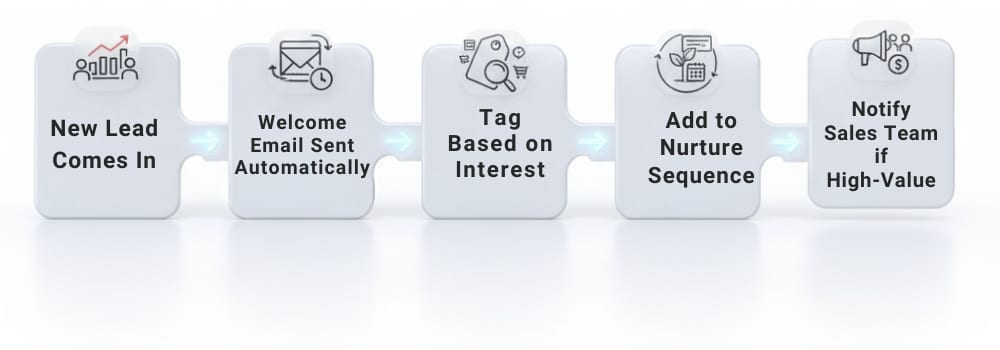
Then build your first email sequences:
- Welcome series for new contacts
- Follow-up series for prospects
- Re-engagement series for past customers
Start simple. You can add complexity later.
Timeline: Week 4 of January through Week 2 of February
Step 4: Launch Lead Nurture and Sales Systems
Turn on your lead nurture sequences. Let them run. Monitor results.
Set up your sales automation:
- Automatic lead scoring
- Task reminders for follow-ups
- Pipeline stage triggers
Watch your sales pipeline fill up and move automatically.
Timeline: Week 3-4 of February
Step 5: Track ROI and Optimize
Start tracking key metrics:
- Lead conversion rates
- Email open and click rates
- Time to close
- Revenue per lead source
Use this data to optimize. Double down on what works. Cut what doesn’t.
This is how you achieve real cost reduction and profit optimization—by knowing what actually drives results.
Timeline: March and ongoing
Why Implementation Matters More Than Perfection
Here’s what holds most businesses back: they want the perfect setup before they launch.
They research every feature. They compare every platform. They wait for the ideal moment when they have time to do it “right.”
Meanwhile, their competitors are launching imperfect systems and learning as they go.
Don’t fall into this trap. A CRM system running at 70% is infinitely better than a perfect system that lives in your head.
83% of small businesses using CRM saw positive ROI, and 61% improved customer retention. These businesses didn’t wait for perfection—they started, learned, and adjusted.
You can too.
Making 2026 Different: Your Next Steps
If you’re reading this in late 2025 or early 2026, you’re in the perfect position. You have the data from last year. You have the momentum of a new year. You have the time in Q1 to implement properly.
What you do in the next few weeks will determine what kind of year you have.
Companies like LeadProspecting AI were built specifically to help small businesses set up these systems without the enterprise complexity or cost. Whether you choose them or another platform, the key is to start now.
Don’t spend another year wishing you had systems. Start 2026 with them already running.
Frequently Asked Questions
Why is early 2026 better than waiting until later in the year to set up a small business CRM?
Early 2026 gives you three advantages: Q1 is typically slower, so you have time to set up properly without the pressure of your busy season. You can use fresh 2025 data to guide what you track and optimize. And you’ll have systems running before your busy season hits, allowing you to capture and convert more leads when it matters most. Businesses that set up CRM in January see compounding benefits all year. Those who wait until Q3 or Q4 miss most of the year’s growth potential.
How long does it actually take to set up a small business CRM?
With the right platform, you can be operational in 4-6 weeks. Week 1: Choose your CRM. Weeks 2-3: Import and organize your data. Weeks 4-5: Build basic automation workflows. Week 6: Launch and start tracking. Research shows that initial benefits like improved data organization and automated workflows often appear within 90 days, meaning you can be capturing and nurturing leads effectively by the end of February if you start in January.
What’s the ROI of implementing a small business CRM in early 2026?
According to CRM.org, businesses see an average ROI of $8.71 for every dollar spent on CRM. CRM applications can increase sales by up to 29% due to consistent follow-up and better lead management. 91% of businesses report a reduction in customer acquisition costs after implementing CRM software. Customer retention improves because you’re staying in touch automatically. Most businesses see positive ROI within 3-12 months, with full financial returns typically realized by month 12.
What if I’m not technical? Can I still set up CRM automation myself?
Yes. Look for platforms with visual workflow builders, pre-built templates, and drag-and-drop interfaces. Modern CRM software is designed for business owners, not developers. If you can send an email and organize a spreadsheet, you can build basic automation. The key is choosing a platform built for small businesses rather than enterprise tools that require consultants and technical teams.
Is my business too small for a CRM?
If you have more than 20 contacts and want to grow, you need a CRM. Small businesses actually benefit most from CRM because they don’t have teams to handle manual follow-up. When 79% of leads generated never convert into sales and 45% of businesses struggle to generate enough leads, you can’t afford to lose opportunities due to lack of systems. The businesses that think they’re “too small” are usually the ones losing the most revenue to disorganization.
What happens if I wait until Q2 or Q3 to set up my small business CRM?
You lose 3-6 months of growth opportunity. Every lead you don’t capture properly is lost revenue. Every follow-up you forget is a missed sale. Every customer who slips away is a relationship you can’t rebuild. The compound effect of CRM means starting in January gives you exponentially better results than starting in July. You’ll also be trying to implement during your busy season instead of having breathing room in Q1, making setup more stressful and less thorough.