
Automation
Why Most Ready-Made Websites Fail to Convert (And What Smart Businesses Do Instead)
July 15, 2025
The Website Trap Most Small Businesses Fall Into
Did you know that 72% of small business websites fail to include a call to action above the fold? That means nearly three-quarters of websites make it hard for visitors to know what to do next—whether it’s calling, booking, or requesting a quote.
This is just one example of the many small business website mistakes that quietly kill conversion rates.
One of the biggest culprits? Ready-made websites.
These are the prebuilt templates offered by website builders, low-cost freelancers, or even some agencies. They’re often sold as a quick and affordable way to “get online”—and in some ways, they are. But too often, these websites are just digital brochures. They look nice, load fast, and check the “we have a website” box. But they don’t generate leads, follow up with visitors, or move people toward a sale.
That’s because there’s a major difference between having a site and having a lead generation system.
Smart business owners are starting to realize this. They’re shifting from static websites to systems designed around conversion, automation, and CRM integration. These systems don’t just sit online—they actively capture leads, follow up automatically, and help turn interest into revenue.
In this post, we’ll break down why most ready-made websites fail to convert and what smart businesses are doing differently to grow in 2025 and beyond.
The Hidden Problems With Ready-Made Websites
At first glance, ready-made websites seem like a quick win. You choose a template, drop in your logo, maybe swap out a few photos, and you’re online in a matter of days.
But that speed and simplicity often come at a high cost: missed conversions.
Most of these sites weren’t built with strategy in mind. Instead of helping you win customers, they sit quietly online, looking nice—but doing very little.
Here’s why most ready-made websites fail to deliver results:
1. Generic, One-Size-Fits-All Design
Ready-made templates prioritize aesthetics over functionality. They’re designed to look good on a wide range of businesses, not to help your specific business convert visitors. That often means your unique selling proposition (USP) gets buried—or worse, never shown.
“Design that looks good but doesn’t guide behavior is decoration—not UX.”
— Jared Spool, UX Researcher
2. No Lead Magnet or Incentive to Engage
Many small business websites don’t offer a clear reason for a visitor to take action. There’s no lead magnet—no free guide, quote, consultation, or special offer. Without this, visitors rarely feel compelled to give their information or stick around.
3. No Follow-Up System
Even when forms are present, most aren’t connected to a CRM or automation flow. A potential customer might fill out a form, but then what? No confirmation message. No follow-up. Just radio silence.
This is where opportunity dies. A proper follow-up system—automated emails or SMS responses—can dramatically improve conversion rates.
“Conversions don’t happen by accident. They happen when you design with action in mind.”
— HubSpot UX Team
4. Poor CTA Strategy (or None at All)
A surprising number of small business websites don’t guide visitors toward a next step.
According to the Nielsen Norman Group, users often fail to take action not because they aren’t interested—but because the site doesn’t show them what to do next. Common mistakes include:
Buried buttons
Unclear CTA text like “Submit”
Placing calls-to-action too far down the page
“Users often don’t scroll or search for a call to action. If it’s not immediately obvious what to do next, they’ll leave.”
— Nielsen Norman Group
And it’s not just anecdotal—CTA placement and design have a measurable impact:
CTA above the fold increases conversion by up to 84% (Nielsen Norman Group)
Personalized CTAs convert 202% better than generic ones (HubSpot)
70% of small business websites lack a call to action on their homepage (Small Business Trends)
Only 47% of websites have a clear CTA on each landing page (SmallBizGenius)
CTA Design Matters: A Side-by-Side Comparison
| Low-Converting CTA<br>(Typical of Ready-Made Sites) | High-Converting CTA<br>(Conversion-Focused Design) |
|---|---|
| “Submit” or “Contact Us” button text | Action-oriented button like “Book Your Free Estimate Now” |
| CTA placed at the very bottom of the page | CTA visible above the fold on every key page |
| No value proposition or incentive | Clear offer or benefit (e.g., free quote, consultation) |
| One-time form with no follow-up | Connected to CRM and automation for instant follow-up |
| No urgency or timeline | Uses urgency or scarcity (e.g., “Limited Spots Available”) |
| Generic or no thank-you page | Confirmation message with next steps or booking options |
In short: pretty doesn’t equal profitable.
A polished design may feel professional, but if the site lacks user flow, lead capture, and follow-up—it won’t help your business grow. What good is a nice-looking website if it doesn’t bring in leads, close deals, or drive revenue?
That’s the core issue with most ready-made websites:
They were built to exist—not to perform.
Why a Lead Generation Website Needs Automation to Win
Most business owners think their website is working if the phone rings once in a while. But the truth is, they’re missing a massive part of the lead picture.
If you’re only tracking leads that call you directly—and not the ones who fill out a form, leave a message, or bounce without hearing back—you’re likely losing more business than you realize.
That’s because a lead generation website can’t succeed on design alone. It needs a system behind it.
Here’s where most websites fall short: they capture the lead… and then nothing happens. There’s no automated reply, no confirmation, no follow-up. And in the age of instant everything, that silence kills your chances of turning interest into a sale.
The Real Conversion Killer: No Follow-Up
Imagine this scenario:
A visitor fills out your “Request a Quote” form at 9:30 PM.
They don’t hear back until 3:00 PM the next day—or worse, never.
By then, they’ve contacted three competitors and booked someone else.
This isn’t rare. It’s the norm for businesses without automation. And it’s exactly why automation isn’t optional anymore—it’s essential.
What Smart Lead Generation Websites Do Instead
To actually convert leads, your website needs to connect directly to your CRM and marketing automation system. That means when someone fills out a form, the system doesn’t just store their information—it responds.
Here’s how it should look:
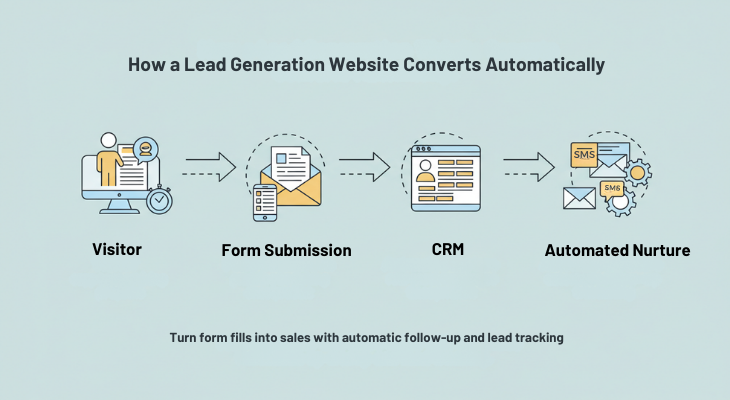
Visitor browses your site and fills out a form
The CRM immediately tags the lead and stores their info
An automated email or SMS confirms their request, thanks them, and tells them what to expect next
Over the next few days, they receive a personalized follow-up sequence that builds trust and moves them closer to booking
This simple shift—from a static site to a lead generation website powered by automation—makes a measurable difference. Instead of hoping leads will follow up with you, you follow up with them automatically.
That responsiveness builds trust. And trust leads to conversions.
CRM-Integrated Websites: Built to Convert, Built to Scale
Most small business websites are disconnected islands. A visitor might fill out a form—but that information goes nowhere helpful. There’s no tracking, no follow-up, no insight into what happens next.
A CRM-integrated website changes that.
It’s not just a digital storefront—it’s the front end of a full business system.
What Is a CRM-Integrated Website?
A CRM-integrated website is one that connects directly to your customer relationship management (CRM) system. Every form submission, appointment request, or contact inquiry is automatically logged and tracked. From there, smart workflows take over—turning passive leads into active sales opportunities.
Here’s what that enables:
Contact storage: Every lead is captured and organized in your CRM, complete with name, contact info, source, and behavior.
Automated tagging and segmentation: Leads are sorted into categories—new, warm, repeat, or cold—based on your rules.
Pipeline visibility: You can see where each prospect is in the buying journey.
Follow-up and nurture flows: Emails and SMS sequences are triggered automatically based on actions they take (or don’t take).
According to Salesforce’s Small & Medium Business Trends Report, 66% of growing SMBs use a CRM to automate and track customer interactions, and those that do are significantly more likely to exceed revenue goals.
HubSpot research also shows that companies using CRMs effectively see an average of 29% more sales productivity and 41% better forecast accuracy.
Real Example: What Automation Looks Like in Action
Let’s say someone fills out a contact form to request a roof inspection:
They immediately receive a personalized SMS that confirms their request and sets expectations (“Thanks for reaching out! Our team will contact you within 1 business day.”)
An email follows with a link to your calendar so they can book a call right away.
In your dashboard, that lead is logged and tagged as “New – Roofing Inquiry.”
If they don’t book a call within 24 hours, your system sends a gentle reminder automatically.
No leads fall through the cracks. And no one waits around wondering if they’ll hear back.
That’s the power of a CRM-integrated website. It scales your responsiveness, organizes your pipeline, and ensures no opportunity is lost just because someone forgot to follow up.
An Automated Follow-Up System = More Sales
You’ve done the hard work—someone found your website, filled out a form, and showed interest. But if you don’t respond quickly—or at all—you’re not just losing a sale. You’re wasting the lead entirely.
According to InsideSales (now XANT), a staggering 78% of leads never convert simply because there’s no follow-up. Not poor pricing. Not a weak offer. Just a total lack of timely response.
This is where an automated follow-up system makes all the difference.
The Problem: Manual Follow-Up is Inconsistent
For most small businesses, following up means:
Manually checking email for form submissions
Setting reminders to respond (and often forgetting)
Trying to juggle texts, calls, and replies across multiple channels
It’s easy for leads to slip through the cracks—especially after hours or on weekends.
The Solution: Automate the First Touch (and the Rest)
With a proper automated follow-up system, your business responds instantly—even when you’re off the clock.
Here’s what it can look like:
A new lead fills out your website form at 8:47 PM.
Within seconds, they receive an automated SMS and email:
“Thanks for reaching out! We’ve received your request and will get back to you by tomorrow morning. In the meantime, here’s a link to our calendar if you’d like to book a time.”That message is logged in your CRM. If the lead doesn’t book a call within 24 hours, a gentle reminder is automatically sent.
If they still don’t engage, the system tags them as “cold” and moves them into a monthly check-in sequence.
Case Study: How a Cleaning Business Saves Time and Closes More Jobs
A local cleaning company implemented a basic automation setup that now handles:
Appointment reminders via SMS and email the day before and an hour before each job
Missed call text-back, so no inquiry ever goes unanswered
Post-service follow-ups that ask for reviews, include referral offers, and rebook regular customers
The result? Fewer no-shows, more repeat clients, and a consistent stream of 5-star reviews—all without lifting a finger.
That’s the power of a smart automated follow-up system:
It builds trust, reduces friction, and keeps your leads warm without the manual effort.
DIY vs Professional Website: What’s Actually Worth Your Time?
With today’s website builders promising “drag and drop” ease and budget-friendly pricing, it’s tempting for small business owners to take the DIY route. But while building your own site might save money upfront, the long-term ROI tells a different story.
Most DIY sites fail not because the owner didn’t try—but because conversion strategy wasn’t part of the build.
The Real Cost of DIY Websites
Let’s say you spend 20 hours learning how to use a drag-and-drop builder. You upload some images, write copy, and launch your site. A few months later, you realize it’s not getting leads. So you tweak it. Update the text. Change the layout.
But conversions still don’t come.
Why? Because DIY sites often lack:
Conversion-focused layout
Mobile optimization
CRM integration
Automation
Analytics to measure what’s working
And unless you have expertise in marketing and UX, you’re probably building something that looks decent—but doesn’t perform.
Meanwhile, those 20–40 hours you spent? That’s time you weren’t spending selling, networking, or actually running your business.
“DIY websites give business owners a false sense of progress. But design without strategy is just decoration.”
— Anonymous UX strategist
Let’s Compare: DIY vs Professional Website Outcomes
Here’s a table to help clarify the trade-offs:
| Category | DIY Website | Professional Website (Strategy-First) |
|---|---|---|
| Initial Cost | Low (monthly builder fee or template purchase) | Higher upfront, but includes strategy + setup |
| Time Investment | 20–40+ hours of your own time | 2–4 hours of review, feedback, and approvals |
| Conversion Strategy | Rarely included | Built around lead generation and CTA placement |
| CRM & Automation | Not included or difficult to integrate | Fully integrated (forms, follow-up, pipelines) |
| Mobile Optimization | Depends on template | Custom-optimized for mobile experience |
| Performance Tracking | Minimal analytics | Real-time dashboards and lead tracking |
| Scalability | Hard to expand or customize | Built to grow with your business |
| Outcome | Looks okay, but rarely converts | Designed to capture leads and drive revenue |
The ROI Equation
Saving $2,000 upfront sounds good—until you realize that your DIY website cost you 30 hours, missed leads, and months without real traction.
Smart businesses look at ROI differently. They ask:
What’s the lifetime value of one customer?
How many leads am I losing while trying to save a buck?
What could I earn if my website was actually working 24/7?
Marketing Automation for Small Business Owners Who Want to Scale
For years, marketing automation was a luxury only big companies could afford. Complex software. Expensive consultants. Long setup times.
But that’s changed.
Today, marketing automation for small business is not only possible—it’s a competitive advantage. It levels the playing field by letting small teams do what used to take a full marketing department.
What Does Marketing Automation Actually Include?
When people hear “automation,” they often think of spammy email blasts or robots replacing human interaction. But real automation is about consistency, speed, and follow-through—without burning out your team.
Here’s what it can include:
Email campaigns – nurture leads with timely messages based on their behavior
Review requests – automatically ask happy customers for reviews (and follow up if they don’t respond)
SMS reminders – confirm appointments, reduce no-shows, and keep communication flowing
Post-sale follow-up – upsell, cross-sell, and stay top-of-mind for repeat business
Missed call text-backs – instantly respond to inbound calls you couldn’t answer
With the right setup, this all happens in the background—while you focus on delivering your service.
Simple, Powerful, and Built for You
The problem with many automation platforms is complexity. Small business owners don’t have time to learn enterprise tools—or pay someone thousands to do it for them.
That’s where LeadProspectingAI comes in.
We’ve built our platform specifically for small business needs. Everything is connected—your website, CRM, forms, calendars, reviews, and follow-ups—so you can focus on growth, not tech headaches.
No piecing together 6 different tools. No marketing agency retainers. Just one system designed to help you win.
A Website Without Automation Is Like a Store With No Staff
Imagine walking into a retail store and… no one greets you. No one answers your questions. There’s no checkout counter, no signage, and no one follows up after you leave.
That’s what a website without automation feels like to most leads.
It may look nice—but it doesn’t sell, serve, or scale.
Smart businesses know that design gets you noticed—but automation gets you paid.
Turn Your Website Into a Growth Engine
Ready-made websites aren’t inherently bad—they’re just incomplete.
They give you a place online, but they don’t give you a system. And in 2025, having an “online presence” isn’t enough. You need a growth engine.
That means shifting how you think about your website—from a digital brochure to a fully integrated sales and marketing platform.
Let’s recap what smart businesses are doing differently:
They stop relying on generic templates and start building for conversion.
They connect their websites to CRMs, automating lead capture and follow-up.
They don’t let leads slip through the cracks—they respond instantly and consistently.
They scale smarter with marketing automation, even as a one-person team.
If your site isn’t doing that yet, you’re not alone—but now is the time to fix it.
Frequently Asked Questions About Ready-Made Websites and Conversion Strategy
1. What is a ready-made website?
A ready-made website is typically a pre-designed site built using templates or drag-and-drop builders like Wix, Squarespace, or GoDaddy. These sites are quick to launch and easy to manage, but often lack the strategy, automation, and CRM integration needed to turn visitors into paying customers.
2. Why don’t ready-made websites convert leads?
Ready-made websites often focus on appearance, not performance. Most lack a clear call to action, lead magnets, follow-up systems, or CRM connectivity. Without those elements, visitors may browse—but they rarely take the next step. A 2025 study by WebFX found that template-based websites convert 64% fewer leads than CRM-integrated sites.
3. What’s the difference between a website and a lead generation website?
A regular website shares information. A lead generation website is built to collect leads, automate follow-up, and track engagement. It’s connected to a CRM, uses forms and landing pages with CTAs, and includes automation that moves visitors toward a sale—even while you sleep.
4. How can I optimize my website for more conversions?
To improve conversions in 2025, focus on:
Placing CTAs above the fold
Adding lead magnets (like free quotes or guides)
Using social proof (testimonials or reviews)
Automating follow-up via email/SMS
Integrating with a CRM to track leads and behavior
Google’s Helpful Content updates also reward sites that show clear user intent, fast load times, and mobile responsiveness.
5. Do I need a CRM for my small business website?
Yes—especially if you want to grow. A CRM (Customer Relationship Management system) helps you track leads, automate outreach, manage pipelines, and close more deals. In 2025, businesses that use CRM systems report 41% higher customer retention and 29% more sales, according to HubSpot.
6. How does automation improve website performance?
Automation turns a static website into a responsive sales engine. It sends instant replies when someone fills out a form, follows up if they don’t respond, requests reviews after a sale, and helps re-engage cold leads over time. You get faster response times, fewer no-shows, and more sales—without more manual work.
7. What’s better: a DIY website or a professionally built one?
A DIY website might be cheaper upfront, but often lacks the tools and strategy to generate ROI. A professionally built, CRM-integrated website includes conversion-focused design, automation, and long-term scalability. Most small businesses recoup the cost of a pro site within the first few closed deals.
8. What features make a small business website successful?
In 2025, high-performing small business websites typically include:
Mobile-first design
Fast load speed (under 3 seconds)
CRM and automation integration
Clear CTA on every page
Forms connected to workflows
Live chat or SMS response options
SEO-optimized blog content
9. How can follow-up automation help me get more sales?
Follow-up automation ensures no lead slips through the cracks. It sends timely messages when someone reaches out, reminds them to take action, and builds trust with consistent communication. Businesses that automate follow-up see up to 300% more conversions from web leads.
10. Can LeadProspectingAI build a CRM-integrated website for my business?
Yes. LeadProspectingAI specializes in building high-converting, CRM-integrated websites for small business owners. Every site we launch includes custom automation flows, form tracking, booking calendars, and follow-up systems—all tailored to your sales process.