If you run a business in Twin Falls, Jerome, Burley, or anywhere across the Magic Valley, you already know that word of mouth only carries so far. At some point, growth depends on new prospects findin

If you run a business in Twin Falls, Jerome, Burley, or anywhere across the Magic Valley, you already know that word of mouth only carries so far. At some point, growth depends on new prospects findin

If you run a business in Twin Falls, Jerome, Burley, or anywhere across the Magic Valley, you already know that word of mouth only carries so far. At some point, growth depends on new prospects finding you, and in 2026, the way they find you has changed.
Most lead prospecting advice focuses on outbound tactics: cold calls, email sequences, and CRM automation. That advice assumes prospects already know you exist. But for local businesses competing in a market like southern Idaho, the real question comes earlier: when someone in Twin Falls searches for a service you offer, do they find your business or your competitor’s?
If your Google Business Profile is half-finished, your website loads slowly on a phone, or a competitor in Jerome is outranking you in every local search result, no amount of outreach effort fixes that gap. The foundation of lead prospecting for Magic Valley businesses is not how hard you chase, but whether you show up when local customers are already looking.
This guide covers the prospecting factors that actually drive leads for businesses in our region, starting with the ones most local companies overlook entirely.
When a homeowner in Burley needs a plumber, they do not flip through the phone book. When a business owner in Kimberly needs an accountant, they do not drive around looking for signs. They search on their phone. They type a few words into Google, glance at the results, and make a decision in seconds based on what shows up.
For Magic Valley businesses, that moment is the real starting point of lead prospecting. If your business does not appear in the local map pack or the top organic results for your service area, you are invisible to the majority of high-intent prospects in the region. They are not choosing your competitor because the competitor is better; they are choosing the competitor because the competitor showed up first.
This is especially true in a market like ours. The Magic Valley is large enough to support real competition across most service categories, but small enough that a handful of businesses dominate local search results. If you are not one of them, the leads flow to the businesses that are. And most of those businesses earned that position not through bigger budgets, but through stronger digital fundamentals.
For any business serving Twin Falls, Jerome, Burley, Rupert, Hailey, or the surrounding communities, the Google Business Profile is often the very first thing a local prospect sees. It shows up in map results, local search packs, and increasingly in AI-generated search summaries. It displays your reviews, your hours, your photos, and your location before a prospect ever visits your website.
Most Magic Valley businesses have a Google Business Profile. Far fewer have one that is actually optimized.
An incomplete profile, missing service categories, no recent photos, outdated hours, and a generic business description tell prospects that you are either not active or not paying attention. In a community-driven market like southern Idaho, that impression matters. People here want to do business with companies they trust, and trust starts with what they see online before they ever make a call.
The businesses generating consistent local leads treat their profile like a living asset. They keep their categories specific to their actual services rather than using broad generic terms. They upload new photos regularly, job sites, team members, completed projects, so the profile looks active and current. They respond to every review, because in a tight-knit market like the Magic Valley, prospects read those responses and judge how you handle both praise and criticism.
Equally important is NAP consistency, making sure your business name, address, and phone number are identical across your website, Google profile, Yelp, Facebook, the Twin Falls Area Chamber directory, and every other platform where you appear. When this information conflicts, Google loses confidence in your listing and your rankings drop. Prospects who see different phone numbers or addresses on different sites lose confidence too.
If you have not reviewed your Google Business Profile recently, it is likely costing you leads from the very community you serve.
Once a local prospect clicks through to your website, whether from a Google search, a Facebook link, or a recommendation from a friend, you have a very short window to convince them to stay. Most visitors decide within ten seconds whether to engage or bounce.
Three things determine that decision for Magic Valley prospects specifically.
First, speed. If your website takes more than three seconds to load on a mobile device, a significant number of visitors leave before seeing anything. This is not a problem unique to our area, but it hits local businesses hard because many local sites were built years ago and have never been optimized for modern mobile performance. A prospect searching for “HVAC repair Twin Falls” on their phone while their furnace is out is not going to wait for a slow site to load. They will tap the back button and call the next result.
Second, mobile experience. More than half of local searches happen on phones, and for urgent service needs, that number is even higher. If your site requires pinching and zooming to read, if buttons are too small to tap accurately, or if your contact information is buried three pages deep, you are losing the most motivated prospects in your pipeline, people who are ready to act right now.
Third, a clear next step. When someone lands on your site, they should immediately see what you do, where you serve, and how to contact you. A prominent phone number with click-to-call functionality. A simple contact form. A clear description of your service area that mentions Twin Falls, Jerome, Burley, and the other communities you cover. Without these, even a fast and attractive website fails as a lead generation tool.
Most local business owners have not tested their own website from the perspective of a first-time visitor on a phone. Try it. The experience might explain why leads have been slower than expected.
For Magic Valley businesses, search engine rankings are not a vanity metric; they are the difference between a full pipeline and a quiet phone.
Here is the reality: when someone searches “electrician near me” from Twin Falls, Google returns a handful of results. The local map pack shows three businesses. The organic results below show a few more. The vast majority of clicks go to those top results. If your business is not in that group, you are functionally invisible to the largest source of high-intent prospects in the region.
These are not casual browsers. Someone searching for a specific service in a specific location has immediate intent. They are comparing options and making a decision, often within minutes. Ranking on page two of Google for your primary local keyword is the equivalent of having a great shop on a street that no one drives down.
What makes local rankings especially important in the Magic Valley is the competitive dynamics. In many service categories, only a handful of businesses have invested in their online presence. That means the barrier to ranking well is often lower than businesses expect. The companies that dominate local results are not always the biggest or the best; they are the ones that took the time to optimize their digital presence while competitors neglected theirs.
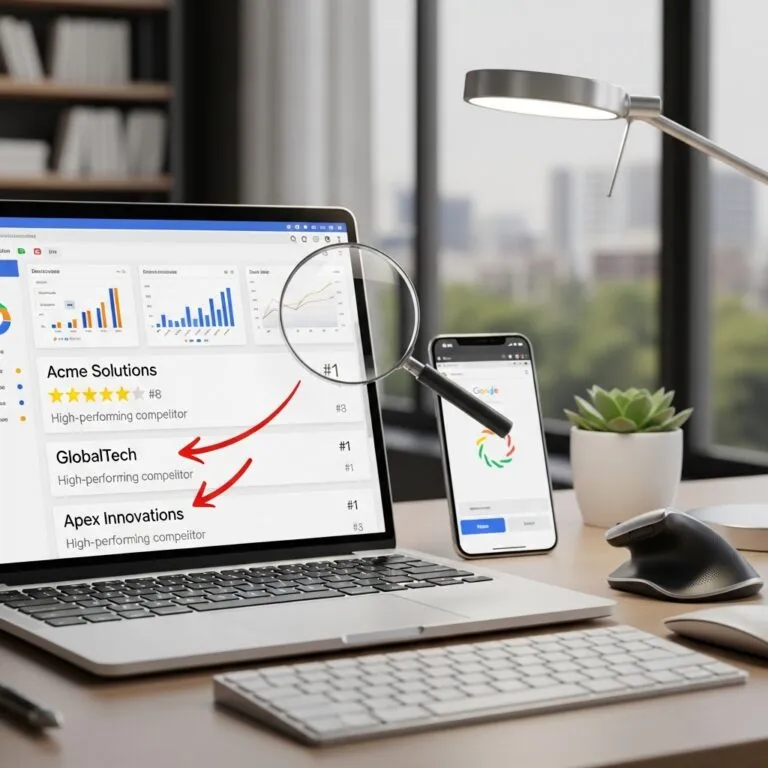
Understanding where you rank relative to your local competitors, and why, is the starting point for any meaningful improvement. Without that competitive picture, you are making decisions based on assumptions rather than data.
Traditional lead scoring assigns points based on CRM activity, emails opened, forms submitted, and calls logged. That system still has value, but it misses the most important signals for local businesses.
The prospects who are most likely to convert are the ones showing intent signals before they ever contact you. Which pages did they visit on your website? Did they check your services page and then your reviews? Did they search for your business by name after visiting your site through a general keyword search? Did they look at your Google Business Profile, click through to your website, and then come back again the next day?
These behavioral patterns reveal buying intent far more reliably than any demographic checkbox. AI-powered scoring tools can now process these signals in real time, helping you prioritize the leads most likely to become customers.
For Magic Valley businesses, this matters because lead volume is naturally smaller than in major metro areas. When you are working with a tighter pool of prospects, the ability to identify and prioritize the most qualified ones is not a luxury; it is how you make the most of every opportunity your market provides.
Search behavior is shifting in ways that directly affect Magic Valley businesses. AI-powered search features, Google’s AI Overviews, conversational assistants, and voice search are changing how local prospects discover and evaluate service providers. Instead of scrolling through a list of results, users increasingly receive summarized recommendations drawn from multiple sources.
The businesses that appear in these AI-generated summaries are the ones with the strongest digital signals: consistent information across platforms, well-structured website content, genuine customer reviews, and clear service descriptions that match what people actually search for.
For a local business, the practical steps are straightforward. Answer common customer questions directly on your website. Make sure your service descriptions match the terms real people use when searching in our area. Keep your information consistent everywhere you appear online. Build a genuine review profile that gives AI systems evidence of real customer experience. These fundamentals feed both traditional search engines and the AI layers now built on top of them.
Every prospecting tactic works better when it is built on a clear understanding of your starting position. Most Magic Valley businesses have never systematically evaluated how they appear online. They do not know where they rank for their most important local keywords. They have not compared their Google Business Profile to their top competitors in Twin Falls or Jerome. They have not tested their site speed on a phone or checked whether their business information is consistent across directories.
Without that baseline, every marketing dollar is a guess. You might pay for ads when your Google profile is turning away the traffic you already have. You might invest in social media when your website is losing every prospect who clicks through.
The first step is a diagnostic, an honest look at what prospects in the Magic Valley actually see when they search for a business like yours.
[Run your free website audit here] and find out exactly how your business appears in local search results, how your website performs, and where you stand against competitors in your area. It takes a few minutes and shows you exactly where to focus.
How does local search visibility affect lead prospecting for Magic Valley businesses? When someone in Twin Falls, Jerome, or Burley searches for a service, they typically click one of the first few results. If your business does not appear in the local map pack or top organic results, you are invisible to the largest pool of ready-to-act prospects in the region. Improving local visibility is the most direct way to increase inbound lead volume.
Why does my Google Business Profile matter for getting leads in Twin Falls? Your Google Business Profile is often the first thing a local prospect sees, before your website, before your social media, before anything else. An incomplete or outdated profile with few reviews and no recent photos signals neglect and pushes prospects toward competitors who look more active and trustworthy.
How does website speed affect lead generation for local businesses? If your site takes more than three seconds to load on mobile, many visitors leave before seeing any content. For local service searches, where people are often searching with urgent needs, a slow website sends motivated, ready-to-buy prospects directly to your competitor’s site instead.
What is NAP consistency and why does it matter? NAP stands for Name, Address, and Phone number. When your business information is different across your website, Google profile, social media, and local directories, search engines lose confidence in your listing and rank you lower. Prospects who see conflicting information also lose trust. Consistency across all platforms is a basic but critical factor in local search rankings.
How can I find out where my business stands in local search results? A comprehensive website audit evaluates your search rankings, Google Business Profile completeness, website performance, mobile experience, and competitive positioning, all in one report. It gives you a clear picture of what local prospects actually see when they search, and where to focus your efforts for the biggest impact.
For businesses that want to manage leads, scheduling, follow-ups, and customer communication in one system, FieldServ AI brings those pieces together without added complexity.
Written by
LPAI Team
Helping businesses grow with AI-powered lead generation, CRM automation, and data-driven marketing strategies.

Real 2026 cost per lead benchmarks for Magic Valley home service businesses show wide CPL ranges, local competition impacts costs, and smart follow-up systems dramatically lower true acquisition expenses.

Discover the real cost per lead in 2026. Learn benchmarks, hidden expenses, and proven strategies small businesses use to reduce CPL, improve conversions, and grow smarter.

Most lead generation guides start with the same advice: install a chatbot, build a pipeline, and automate your follow-up. But if your Twin Falls business is practically invisible in local search resul
Manage contacts, projects, appointments, and billing — everything in one place.
See PlansIf you run a business in Twin Falls, Jerome, Burley, or anywhere across the Magic Valley, you already know that word of mouth only carries so far. At some point, growth depends on new prospects finding you, and in 2026, the way they find you has changed.
Most lead prospecting advice focuses on outbound tactics: cold calls, email sequences, and CRM automation. That advice assumes prospects already know you exist. But for local businesses competing in a market like southern Idaho, the real question comes earlier: when someone in Twin Falls searches for a service you offer, do they find your business or your competitor’s?
If your Google Business Profile is half-finished, your website loads slowly on a phone, or a competitor in Jerome is outranking you in every local search result, no amount of outreach effort fixes that gap. The foundation of lead prospecting for Magic Valley businesses is not how hard you chase, but whether you show up when local customers are already looking.
This guide covers the prospecting factors that actually drive leads for businesses in our region, starting with the ones most local companies overlook entirely.
When a homeowner in Burley needs a plumber, they do not flip through the phone book. When a business owner in Kimberly needs an accountant, they do not drive around looking for signs. They search on their phone. They type a few words into Google, glance at the results, and make a decision in seconds based on what shows up.
For Magic Valley businesses, that moment is the real starting point of lead prospecting. If your business does not appear in the local map pack or the top organic results for your service area, you are invisible to the majority of high-intent prospects in the region. They are not choosing your competitor because the competitor is better; they are choosing the competitor because the competitor showed up first.
This is especially true in a market like ours. The Magic Valley is large enough to support real competition across most service categories, but small enough that a handful of businesses dominate local search results. If you are not one of them, the leads flow to the businesses that are. And most of those businesses earned that position not through bigger budgets, but through stronger digital fundamentals.
For any business serving Twin Falls, Jerome, Burley, Rupert, Hailey, or the surrounding communities, the Google Business Profile is often the very first thing a local prospect sees. It shows up in map results, local search packs, and increasingly in AI-generated search summaries. It displays your reviews, your hours, your photos, and your location before a prospect ever visits your website.
Most Magic Valley businesses have a Google Business Profile. Far fewer have one that is actually optimized.
An incomplete profile, missing service categories, no recent photos, outdated hours, and a generic business description tell prospects that you are either not active or not paying attention. In a community-driven market like southern Idaho, that impression matters. People here want to do business with companies they trust, and trust starts with what they see online before they ever make a call.
The businesses generating consistent local leads treat their profile like a living asset. They keep their categories specific to their actual services rather than using broad generic terms. They upload new photos regularly, job sites, team members, completed projects, so the profile looks active and current. They respond to every review, because in a tight-knit market like the Magic Valley, prospects read those responses and judge how you handle both praise and criticism.
Equally important is NAP consistency, making sure your business name, address, and phone number are identical across your website, Google profile, Yelp, Facebook, the Twin Falls Area Chamber directory, and every other platform where you appear. When this information conflicts, Google loses confidence in your listing and your rankings drop. Prospects who see different phone numbers or addresses on different sites lose confidence too.
If you have not reviewed your Google Business Profile recently, it is likely costing you leads from the very community you serve.
Once a local prospect clicks through to your website, whether from a Google search, a Facebook link, or a recommendation from a friend, you have a very short window to convince them to stay. Most visitors decide within ten seconds whether to engage or bounce.
Three things determine that decision for Magic Valley prospects specifically.
First, speed. If your website takes more than three seconds to load on a mobile device, a significant number of visitors leave before seeing anything. This is not a problem unique to our area, but it hits local businesses hard because many local sites were built years ago and have never been optimized for modern mobile performance. A prospect searching for “HVAC repair Twin Falls” on their phone while their furnace is out is not going to wait for a slow site to load. They will tap the back button and call the next result.
Second, mobile experience. More than half of local searches happen on phones, and for urgent service needs, that number is even higher. If your site requires pinching and zooming to read, if buttons are too small to tap accurately, or if your contact information is buried three pages deep, you are losing the most motivated prospects in your pipeline, people who are ready to act right now.
Third, a clear next step. When someone lands on your site, they should immediately see what you do, where you serve, and how to contact you. A prominent phone number with click-to-call functionality. A simple contact form. A clear description of your service area that mentions Twin Falls, Jerome, Burley, and the other communities you cover. Without these, even a fast and attractive website fails as a lead generation tool.
Most local business owners have not tested their own website from the perspective of a first-time visitor on a phone. Try it. The experience might explain why leads have been slower than expected.
For Magic Valley businesses, search engine rankings are not a vanity metric; they are the difference between a full pipeline and a quiet phone.
Here is the reality: when someone searches “electrician near me” from Twin Falls, Google returns a handful of results. The local map pack shows three businesses. The organic results below show a few more. The vast majority of clicks go to those top results. If your business is not in that group, you are functionally invisible to the largest source of high-intent prospects in the region.
These are not casual browsers. Someone searching for a specific service in a specific location has immediate intent. They are comparing options and making a decision, often within minutes. Ranking on page two of Google for your primary local keyword is the equivalent of having a great shop on a street that no one drives down.
What makes local rankings especially important in the Magic Valley is the competitive dynamics. In many service categories, only a handful of businesses have invested in their online presence. That means the barrier to ranking well is often lower than businesses expect. The companies that dominate local results are not always the biggest or the best; they are the ones that took the time to optimize their digital presence while competitors neglected theirs.
Understanding where you rank relative to your local competitors, and why, is the starting point for any meaningful improvement. Without that competitive picture, you are making decisions based on assumptions rather than data.
Traditional lead scoring assigns points based on CRM activity, emails opened, forms submitted, and calls logged. That system still has value, but it misses the most important signals for local businesses.
The prospects who are most likely to convert are the ones showing intent signals before they ever contact you. Which pages did they visit on your website? Did they check your services page and then your reviews? Did they search for your business by name after visiting your site through a general keyword search? Did they look at your Google Business Profile, click through to your website, and then come back again the next day?
These behavioral patterns reveal buying intent far more reliably than any demographic checkbox. AI-powered scoring tools can now process these signals in real time, helping you prioritize the leads most likely to become customers.
For Magic Valley businesses, this matters because lead volume is naturally smaller than in major metro areas. When you are working with a tighter pool of prospects, the ability to identify and prioritize the most qualified ones is not a luxury; it is how you make the most of every opportunity your market provides.
Search behavior is shifting in ways that directly affect Magic Valley businesses. AI-powered search features, Google’s AI Overviews, conversational assistants, and voice search are changing how local prospects discover and evaluate service providers. Instead of scrolling through a list of results, users increasingly receive summarized recommendations drawn from multiple sources.
The businesses that appear in these AI-generated summaries are the ones with the strongest digital signals: consistent information across platforms, well-structured website content, genuine customer reviews, and clear service descriptions that match what people actually search for.
For a local business, the practical steps are straightforward. Answer common customer questions directly on your website. Make sure your service descriptions match the terms real people use when searching in our area. Keep your information consistent everywhere you appear online. Build a genuine review profile that gives AI systems evidence of real customer experience. These fundamentals feed both traditional search engines and the AI layers now built on top of them.
Every prospecting tactic works better when it is built on a clear understanding of your starting position. Most Magic Valley businesses have never systematically evaluated how they appear online. They do not know where they rank for their most important local keywords. They have not compared their Google Business Profile to their top competitors in Twin Falls or Jerome. They have not tested their site speed on a phone or checked whether their business information is consistent across directories.
Without that baseline, every marketing dollar is a guess. You might pay for ads when your Google profile is turning away the traffic you already have. You might invest in social media when your website is losing every prospect who clicks through.
The first step is a diagnostic, an honest look at what prospects in the Magic Valley actually see when they search for a business like yours.
[Run your free website audit here] and find out exactly how your business appears in local search results, how your website performs, and where you stand against competitors in your area. It takes a few minutes and shows you exactly where to focus.
How does local search visibility affect lead prospecting for Magic Valley businesses? When someone in Twin Falls, Jerome, or Burley searches for a service, they typically click one of the first few results. If your business does not appear in the local map pack or top organic results, you are invisible to the largest pool of ready-to-act prospects in the region. Improving local visibility is the most direct way to increase inbound lead volume.
Why does my Google Business Profile matter for getting leads in Twin Falls? Your Google Business Profile is often the first thing a local prospect sees, before your website, before your social media, before anything else. An incomplete or outdated profile with few reviews and no recent photos signals neglect and pushes prospects toward competitors who look more active and trustworthy.
How does website speed affect lead generation for local businesses? If your site takes more than three seconds to load on mobile, many visitors leave before seeing any content. For local service searches, where people are often searching with urgent needs, a slow website sends motivated, ready-to-buy prospects directly to your competitor’s site instead.
What is NAP consistency and why does it matter? NAP stands for Name, Address, and Phone number. When your business information is different across your website, Google profile, social media, and local directories, search engines lose confidence in your listing and rank you lower. Prospects who see conflicting information also lose trust. Consistency across all platforms is a basic but critical factor in local search rankings.
How can I find out where my business stands in local search results? A comprehensive website audit evaluates your search rankings, Google Business Profile completeness, website performance, mobile experience, and competitive positioning, all in one report. It gives you a clear picture of what local prospects actually see when they search, and where to focus your efforts for the biggest impact.
For businesses that want to manage leads, scheduling, follow-ups, and customer communication in one system, FieldServ AI brings those pieces together without added complexity.
Written by
LPAI Team
Helping businesses grow with AI-powered lead generation, CRM automation, and data-driven marketing strategies.

Real 2026 cost per lead benchmarks for Magic Valley home service businesses show wide CPL ranges, local competition impacts costs, and smart follow-up systems dramatically lower true acquisition expenses.

Discover the real cost per lead in 2026. Learn benchmarks, hidden expenses, and proven strategies small businesses use to reduce CPL, improve conversions, and grow smarter.

Most lead generation guides start with the same advice: install a chatbot, build a pipeline, and automate your follow-up. But if your Twin Falls business is practically invisible in local search resul
Manage contacts, projects, appointments, and billing — everything in one place.
See Plans