
Business Growth
What Are the Biggest Marketing Challenges for Magic Valley Small Businesses? Marketing Automation and CRM Software Solutions
November 25, 2025

TL;DR:
Small businesses in the Magic Valley face three critical marketing challenges: no time for consistent marketing, limited budgets with unclear ROI, and lack of marketing expertise. These aren’t just inconveniences—they’re revenue killers. Research shows that 73% of small business owners lack confidence in their marketing strategies, and the average business takes 47 hours to respond to leads (when most are lost after just 5 minutes). The solution isn’t working harder—it’s building systems that work for you. Marketing automation delivers a 544% ROI, with 76% of businesses seeing returns within the first year. This article explores practical solutions that Magic Valley businesses can implement today to compete with larger companies without needing massive budgets or marketing teams.
There are two types of small businesses in the Magic Valley right now.
Business A is always busy but never growing. They post on social media when they remember. They send emails occasionally. They mean to follow up with that contractor, but get distracted. Their marketing happens in bursts, usually right after a slow month when panic sets in. Then life gets busy again, and marketing falls off the radar. Repeat.
Business B grows consistently. Not because they work harder or have a bigger team, but because their marketing runs in the background automatically, whether they’re finishing a project or driving between appointments.
The difference between these two businesses isn’t talent, luck, or budget.
It’s systems.
Business A is stuck fighting the same three marketing challenges that plague most small businesses. Business B solved them. And in this article, we’re going to show you exactly how they did it and how automation tools are making it possible for local businesses without big budgets or marketing teams to compete.
The Biggest Marketing Challenges for Magic Valley Small Businesses
If you’re running a small business anywhere in Idaho or across the region, you’ve probably felt all three of these problems at once.
Challenge #1: No Time for Marketing (And What That Really Means)
You know marketing matters. You know you should be emailing your list, posting consistently, following up with leads, creating content, and running campaigns.
But when?
You’re already working 60-hour weeks serving customers. You’re managing operations, putting out fires, and driving between job sites. Marketing is important, but it’s never urgent until it’s too late.
So it gets pushed to tomorrow. And tomorrow. And tomorrow.
The result? Inconsistent lead generation. Sporadic outreach. Leads that go cold because you forgot to follow up. Revenue that feels unpredictable because your marketing only happens when you have time, which is almost never.
This isn’t a time management problem. It’s a system problem. You can’t manually scale marketing. You need automation that works whether you’re busy or not.
According to recent research, 30% of small business owners say driving lead generation is their top marketing challenge, while 27% cite budget constraints. But here’s what’s fascinating: the time challenge isn’t really about having more hours in the day. Most small businesses dedicate less than an hour each day to marketing, yet they’re still drowning in tasks.
The real issue? Manual work doesn’t scale. Every email you send, every follow-up you make, every social post you create consumes time you’ll never get back.
Challenge #2: Limited Budget (With No Clear ROI)
You don’t have unlimited money to throw at marketing. Every dollar counts.
So where do you spend it?
Most small businesses default to paid ads because it feels like the fastest path to results. You put money in, you get leads out. Simple, right?
Except it’s not. Ad costs keep rising. Leads get more expensive. And the moment you stop paying, the leads stop coming. You’re renting attention, not building an asset.
Meanwhile, you’re not investing in automation, email systems, or tools that compound over time. You’re not building a customer database that you own. You’re not creating nurture sequences that convert leads automatically.
The result? You’re spending money but not seeing sustainable growth. You don’t have reliable ROI tracking. You’re guessing, not growing.
Recent data reveals something surprising: companies make $5.44 for every $1 they spend on marketing automation, translating to an ROI of 544%. Even better, 76% of companies see ROI from marketing automation within a year.
Compare that to the diminishing returns of paid advertising. When you build automation systems, you create assets that appreciate over time rather than expenses that evaporate the moment you stop paying.
Challenge #3: No Marketing Expertise (And No One to Hire)
You’re great at what you do. Whether you’re a plumber, an HVAC company, or a landscaper, you’re an expert in your field.
But marketing? That’s a different skill set.
You don’t know how to write compelling emails. You’re not sure what a sales funnel is supposed to look like. You’ve heard of CRM software but don’t know how to use it effectively. Terms like predictive lead scoring, campaign management, and workflow automation sound complicated.
And hiring help? That’s expensive. A full-time marketer costs $50K-$80K a year, money you don’t have. Agencies charge thousands per month with long contracts and unclear results.
So you try to figure it out yourself. You watch YouTube videos between jobs. You piece together free tools. You do your best.
But you’re not a marketer. And your results show it.
The data backs this up: 73% of small and medium-sized businesses admit to a lack of confidence in their current marketing strategies. This crisis of confidence stems largely from insufficient expertise in marketing among business owners.
What Life Looks Like Without Solutions
Let’s be honest about what happens when these three challenges go unsolved.
Inconsistent Lead Generation and Lost Opportunities
Your lead generation is feast or famine. Some months are great. Others are painfully slow. You can’t predict it, and you can’t control it.
Leads come in, but you don’t have time to follow up quickly because you’re finishing a project. By the time you get around to it, they’ve gone with a competitor. Or they’ve forgotten about you entirely.
Here’s the brutal reality: the average lead response time is 47 hours, and just 27% of leads get contacted at all. Meanwhile, leads reached within 5 minutes are 21 times more likely to turn into customers compared to those contacted after half an hour.
You’re leaving money on the table, not because you’re bad at what you do, but because your systems can’t keep up with opportunities.
Wasted Budget on Marketing That Doesn’t Work
You spend money on ads. You try Facebook. You test Google. Some work okay. Some are total duds. But you’re not sure which is which because you’re not tracking properly.
You don’t have ROI tracking in place. You don’t know your lead conversion rates. You’re making decisions based on gut feeling instead of data.
The result? Cost reduction becomes impossible because you don’t know what’s actually working and what’s wasting money.
Always Reacting, Never Growing
You’re stuck in a cycle. When business is slow, you panic and scramble to do more marketing. When business picks up, marketing falls off because you’re too busy serving customers.
You’re always reacting. Never building. Never scaling in a sustainable way.
And the worst part? You know there’s a better way. You’ve seen other businesses grow consistently. You just don’t know how they’re doing it.
Challenge #1 Solved: Getting Time Back Through Automation
Here’s the truth: you don’t need more time. You need systems that work without your constant involvement.
How Email Automation Runs Your Marketing 24/7
A homeowner fills out a form on your website at 2 AM. Rather than waiting until you get to your desk, they immediately receive a welcome email. Three days later, a follow-up with valuable content arrives. A week after that, they receive a case study, and two weeks later, an invitation to schedule a call.
All of this happens automatically while you’re working. You built the sequence once. Now it runs forever.
That’s email automation. And it’s how you stay in front of leads without manually sending every message.
The numbers are compelling: automated emails generate 320% more revenue than non-automated emails, and for every $1 spent on email marketing, the average return is $36.
As someone who’s built automation systems for years (including while developing LeadProspecting Ai), I can tell you this: the visual workflow builders and pre-built templates make it possible for non-technical business owners to set these systems up without being tech experts.
Workflow Automation for Every Repetitive Task
Workflow automation goes beyond email. It’s about connecting every part of your marketing and sales process so things happen automatically:
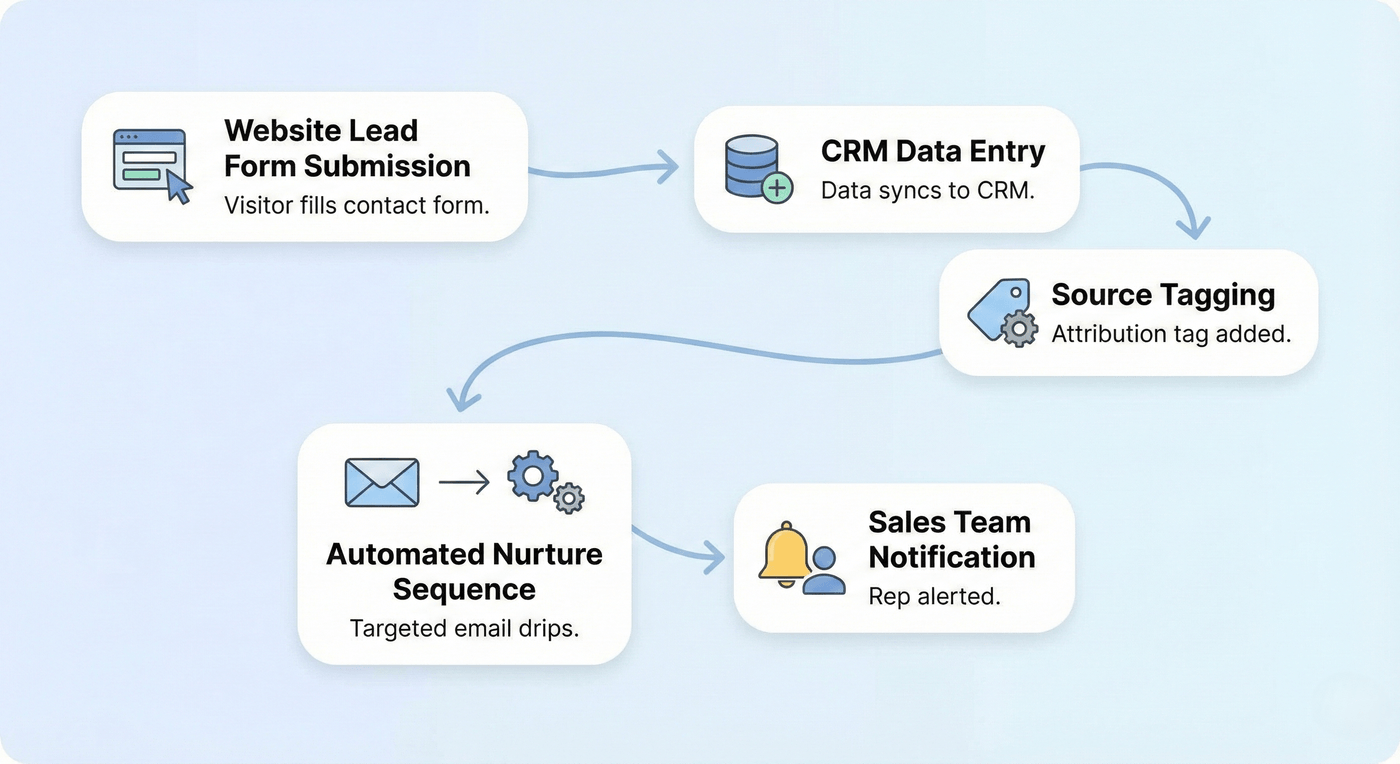
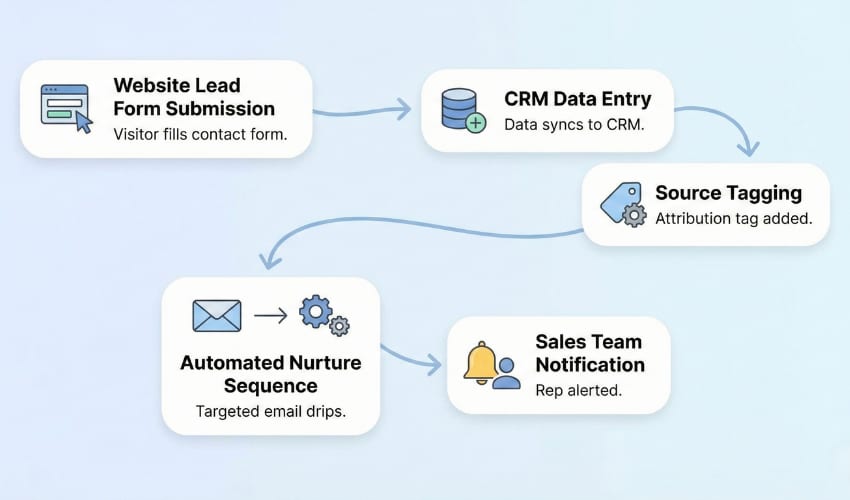
All of this happens without you touching a thing.
Every repetitive task (tagging contacts, moving leads between stages, sending reminders, updating records) gets automated. That’s hours back in your week.
Lead Nurture That Happens Automatically
Not every lead is ready to buy today. Some prospects need time. Some need education. Some need to see your name a few more times before they trust you.
Lead nurture automation solves this. You create sequences that educate, build trust, and stay top-of-mind, all automatically.
By the time that prospect is ready to buy, you’ve already done the work. You didn’t manually follow up 47 times. The system did it for you.
This is how you turn time, your biggest constraint, into a non-issue.
Challenge #2 Solved: Better ROI on a Small Budget
You don’t need a massive budget to compete. You need smarter systems that maximize every dollar.
Why Process Automation Beats Paid Ads for ROI
Paid ads are rented attention. You pay for a click, you get a lead, you pay again next month.
Process automation is owned infrastructure. You build it once, and it works forever. No recurring ad spend. No rising costs. Just systems that generate and convert leads automatically.
A lead comes in through organic search or a referral. Your automation nurtures them. They convert. You didn’t pay for the click. You didn’t pay for the nurture. Your system did the work.
That’s how you get sustainable business growth without burning cash.
Revenue Automation That Compounds Over Time
Revenue automation means your marketing gets better over time, not more expensive.
Your email automation builds a list. That list becomes an asset you can market to for free, forever.
Your CRM tracks every interaction. Over time, you learn what works and double down on it.
Your sales automation converts more leads with less effort because the system handles follow-up, qualification, and nurture.
These compounds. Month over month. Year over year. Without increasing your ad spend.
| Marketing Approach | Year 1 Cost | Year 2 Cost | Year 3 Cost | Cumulative Value |
|---|---|---|---|---|
| Paid Ads Only | $12,000 | $14,400 | $17,280 | Resets to zero |
| Automation-First | $3,600 | $3,600 | $3,600 | Compounds infinitely |
ROI Tracking That Shows What’s Actually Working
You can’t improve what you don’t measure.
With proper ROI tracking, you can see:
- Which lead generation sources actually convert
- Which email sequences drive the most sales
- Which parts of your sales funnel are leaking
- Where to invest more and where to cut back
This visibility transforms marketing from a cost center into a profit driver.
Challenge #3 Solved: Marketing Expertise Without the Price Tag
You don’t need to become a marketing expert. You need tools that embed expertise into the system.
Pre-Built Templates and Proven Frameworks
The good news? You don’t have to figure everything out from scratch. Pre-built templates for email sequences, landing pages, and workflows give you a head start based on what actually works.
These aren’t generic templates. They’re frameworks built from analyzing thousands of successful campaigns across different industries.
For service businesses specifically, the partnership between LeadProspecting Ai and FieldServ Ai has created integrated systems that handle everything from lead capture through service delivery, giving you end-to-end automation without needing to be a systems expert.
Automated Follow-Up Systems That Never Forget
Manual follow-up is where most deals die. You get busy. You forget. The lead moves on.
Automated follow-up systems never forget. They send the right message at the right time, every time. They track engagement and adjust messaging based on behavior.
If someone opens your quote but doesn’t respond, they get different messaging than someone who hasn’t engaged at all.
This systematic approach to customer engagement is what turns inconsistent results into predictable growth.
Data-Driven Insights Without Being a Data Scientist
Modern automation platforms include built-in analytics that show you exactly what’s working. You don’t need to be a data scientist to understand:
- Which campaigns generate the best leads
- Which messages get the highest engagement
- Where prospects typically get stuck in your funnel
- What actions lead to closed deals
These insights let you make smarter decisions without needing a marketing degree.
Real Results: What Happens When You Implement Systems
Let me share what we’ve seen with businesses that have implemented these systems, because the transformation is both measurable and dramatic.
Time Savings That Feel Like Hiring Additional Staff
Business owners consistently report getting 10-20 hours back every week. The automated systems handle follow-ups, appointment scheduling, payment reminders, and review requests (tasks that previously consumed entire afternoons).
One HVAC contractor described it perfectly: “It’s like hiring additional personnel without the overhead.”
Review Growth That Changes Visibility
When businesses turn on review automation, the impact is often dramatic. Companies that averaged 10-15 reviews per year suddenly generate 50, 100, or more.
These reviews create a virtuous cycle: better visibility leads to more traffic, which generates more leads that the automated nurture sequences immediately begin converting.
Conversion Rate Improvements Across the Funnel
The most significant impact shows up in how many inquiries turn into actual customers. Businesses that previously converted 15-20% of leads start converting 30-40% simply because nothing falls through the cracks anymore.
Every lead gets consistent, personalized follow-up until they either buy or clearly opt out.
| Metric | Before Automation | After Automation | Improvement |
|---|---|---|---|
| Lead Response Time | 47 hours | < 5 minutes | 564x faster |
| Follow-Up Consistency | 27% contacted | 100% contacted | 270% increase |
| Conversion Rate | 15-20% | 30-40% | 100% increase |
| Time Spent on Marketing | 10+ hours/week | 2-3 hours/week | 70% reduction |
Getting Started: From Theory to Practice
Understanding these challenges and solutions is one thing. Implementing them is another.
Start With One System
Don’t try to automate everything at once. Start with your biggest pain point:
- If time is your constraint, begin with email automation for new leads
- If budget is your constraint, focus on ROI tracking and organic lead nurture
- If expertise is your constraint: Use pre-built templates and proven workflows
Build on What Works
Once your first system is running smoothly, add another layer. Maybe you start with email automation, then add SMS follow-up, then layer in review requests.
Each system amplifies the others, creating a compound effect on your results.
Consider a Guided Approach
For businesses that want the benefits without the learning curve, programs like the Founders Club offer done-for-you implementation with hands-on support, making it possible to go from manual chaos to automated systems in weeks rather than months.
The Bottom Line for Magic Valley Businesses
The three marketing challenges facing small businesses (no time, limited budget, and lack of expertise) aren’t going away. But they’re completely solvable with the right systems.
Marketing automation isn’t just for enterprise companies anymore. With platforms designed specifically for small businesses, you can:
- Reclaim 10-20 hours per week
- Generate 544% ROI on your marketing spend
- Compete with larger companies on technological sophistication
- Convert 2-3x more leads without increasing ad spend
The businesses growing consistently in your market aren’t working harder than you. They’re not spending more money. They’ve simply built systems that work whether they’re busy or not.
The question isn’t whether automation works (the data proves it does). The question is: how much longer can you afford to operate without it?
Ready to solve these challenges for your business? Start by identifying which of the three challenges hits hardest for you, then build one system to address it. The transformation from reactive to systematic growth starts with a single automated workflow.
Frequently Asked Questions
1. What are the most common marketing challenges small businesses face?
Many businesses struggle with inconsistent lead flow, limited marketing budgets, lack of time to create content, and difficulty tracking which marketing efforts actually produce results. These challenges make it hard to grow sustainably without reliable systems in place.
2. Why is marketing consistency so hard for small, local businesses?
Most owners are busy running day-to-day operations, so marketing often gets pushed aside. Without automated reminders, workflows, or a CRM keeping tasks organized, consistency becomes nearly impossible, leading to missed opportunities.
3. How does automation help small businesses overcome these marketing challenges?
Automation handles repetitive tasks like follow-up messages, lead nurturing, review requests, appointment reminders, and email campaigns. This saves hours every week while ensuring your business stays visible and responsive.
4. Do small businesses really need a CRM system?
If your business wants more predictable revenue, yes. A CRM centralizes contacts, tracks conversations, automates follow-up, and makes sure no lead slips through the cracks (critical for service-based businesses looking to scale).
5. What’s the difference between marketing automation and just posting on social media?
Social posting is only one piece of marketing. Automation supports the entire customer journey (capturing leads, nurturing them, booking appointments, sending reminders, collecting reviews, and even upselling repeat services).
6. How can small businesses compete with larger companies when budgets are limited?
Local businesses can win by being faster, more personal, and more consistent (things automation and a good CRM make easier). You don’t need a large budget when your systems work for you around the clock.
7. How can Magic Valley small businesses use automation to compete locally?
Local businesses in the Magic Valley can leverage automation to respond faster than competitors, maintain consistent communication with prospects, and build stronger relationships through personalized follow-up sequences. While larger companies rely on scale, smaller businesses win with speed and personal touch (automation makes both possible simultaneously).
8. What’s the biggest mistake small businesses make with their marketing?
Trying to do everything manually. Manual follow-up, manual scheduling, manual reminders… it leads to burnout and inconsistent results. Businesses that automate even a few key processes see faster growth with less effort.
8. Can automation really improve lead quality and conversion rates?
Yes. When leads get fast responses, personalized follow-ups, and clear next steps, they convert more often. Automation ensures every lead gets immediate attention, even when you’re busy or closed for the day.
9. Is marketing automation difficult to set up for small business owners?
Not with modern platforms designed for small businesses. Look for tools offering pre-built workflows, simple templates, and guided onboarding so you can launch quickly without needing to be “techy.”
10. How do I know if my business is ready for automation and a CRM?
If you’re losing track of leads, forgetting follow-ups, relying on sticky notes, or spending too much time manually messaging customers, you’re ready. Automation doesn’t replace you; it amplifies your work and keeps your marketing running even on your busiest days.
For additional insights on building automated systems for your business, explore the resources at LeadProspecting Ai’s blog and FieldServ Ai’s blog, where you’ll find practical guides for implementing automation strategies that actually work for small businesses.